AI Chip Substrates Need Glass Adoption Checks
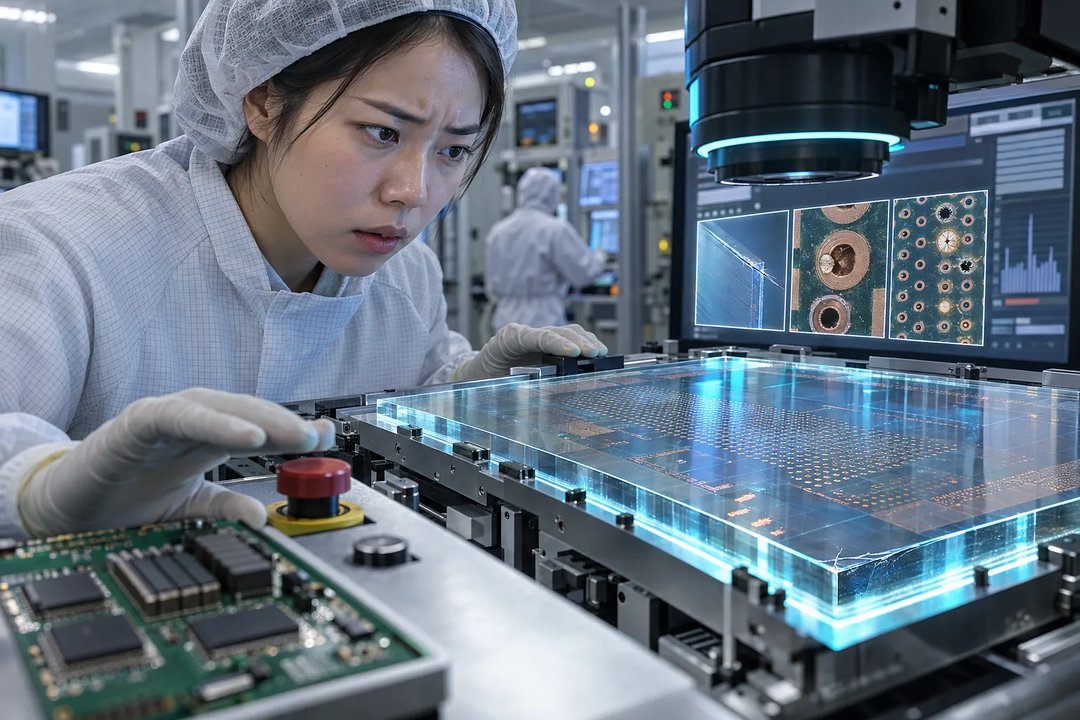
When should you switch from conventional AI chip substrates to glass? The core answer is not after a technology announcement: glass-core substrates merit consideration when large packages need dimensional stability and flatness, but processability, breakage, through-glass vias, metal adhesion, and yield still require validation. No single material replaces every AI system.
The decision is easy to misread because FC-BGA, ABF, multilayer PCBs, MLCCs, glass substrates, and CPO are often discussed as though they perform the same job.
Know What Each Component Actually Does
FC-BGA sits between a semiconductor die and the system board, providing fine wiring plus signal and power connections. ABF is a family of insulating materials used in build-up wiring layers, not another name for the complete FC-BGA structure.
High-layer-count PCBs connect packages and components at system level. MLCCs are passive components that suppress voltage fluctuations and noise; they are not substrates. Keeping these roles separate helps you judge suppliers by relevant products rather than broad AI labels.
Glass Substrate Adoption Depends on the Requirement
Glass offers flatness and adjustable dimensional properties that can reduce alignment errors in large packages. That advantage does not automatically mean better heat dissipation, because cooling depends on thermal conductivity and the entire package and cooling structure.
CPO, which places optical engines near switch chips, can use silicon photonics and organic substrates. Glass is only one possible integration option, so you should not assume that CPO and glass will reach commercialization together.
A Practical Claim-Checking Checklist
- Role: Is the product FC-BGA, a system PCB, an interposer, glass core, or MLCC?
- Stage: Is it development, pilot production, customer qualification, mass production, or recognized revenue?
- Evidence: Do annual reports, facility disclosures, earnings releases, or audited results support the claim?
- Economics: Are yield, utilization, depreciation, and product mix improving alongside adoption?
What the Full Analysis Adds
The original article on Injoys provides role-comparison tables, a GPU-to-HBM signal-path review, substrate selection by requirement, common misconceptions, and a disclosure-based investment verification sequence. Use it to move from technical possibility to evidence of commercial progress.
Read the full article on Injoys
Who Should Use This Framework First
This framework applies when you evaluate high-performance processor packages, AI server boards, chiplet and HBM connections, CPO claims, or companies developing glass substrates. Check glass-related businesses first when publicity mentions samples or facilities without confirming customer qualification, stable yield, mass-production customers, revenue, and profit.
Today, start with the company’s annual report and identify the share of revenue generated by its substrate business, then compare that evidence with the stages explained in the original article on Injoys.
Read the full article on Injoys
This post was written with assistance and published on a channel run by Injoys (injoys.com). The original article and its sources are at the link above.


Comments
Post a Comment