Jagyeongnu 1433 construction and why it matters
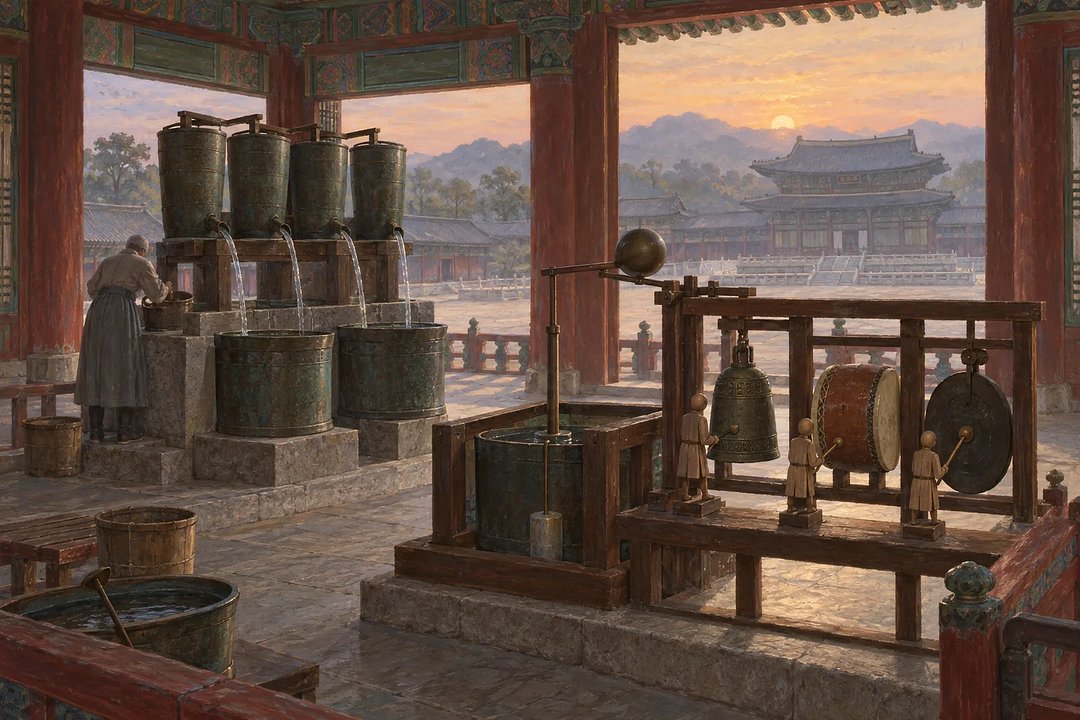
If you are sorting out whether Jagyeongnu dates to 1433 or 1434, separate completion from use. Jang Yeong-sil and others completed this automatic water clock in 1433; the recorded start of use was the first day of the seventh lunar month in 1434. The surviving vessels belong to a later instrument made in 1536.
How water replaced the spoken announcement
Think of two jobs: measuring time and announcing it. Earlier water clocks required an attendant to read a rising rod and give the signal. Jagyeongnu used the rod's movement to release balls through a mechanism that set signaling figures in motion.
The clock's achievement in Joseon, the Korean dynasty ruled by King Sejong, was automating work previously left to an attendant, addressing the risk of mistakes in reading and announcing the time.
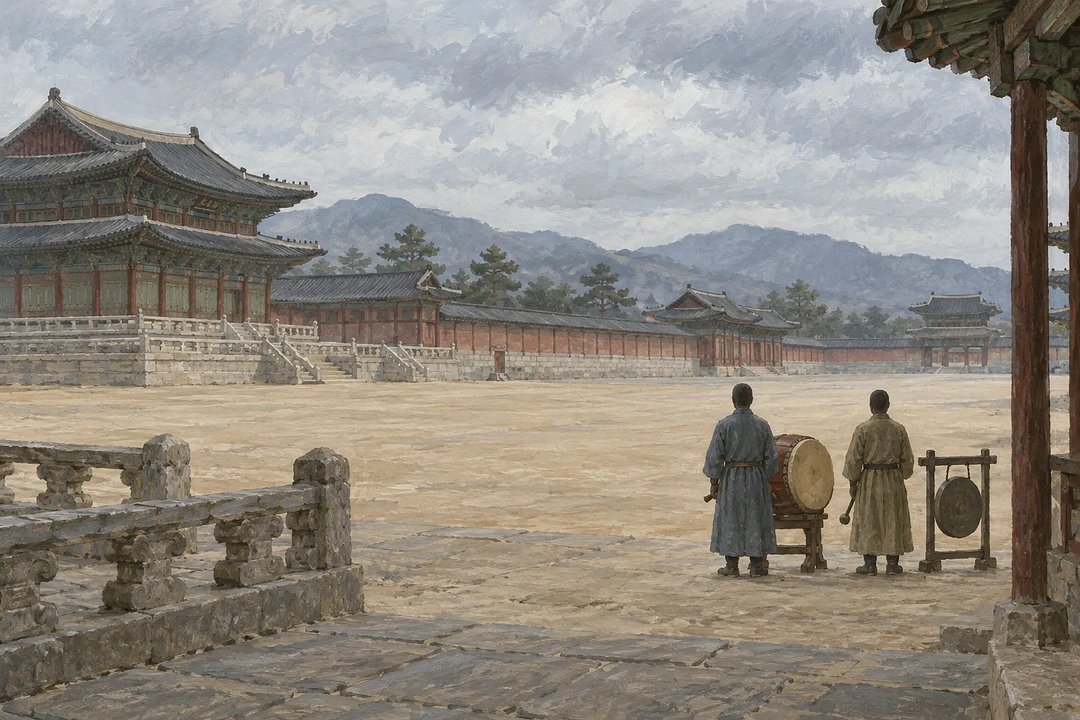 Two attendants stand with their backs turned beside a drum and gong in a broad palace courtyard.
Read the Jagyeongnu records in context
The original article on Injoys pairs a dated timeline with comparisons of earlier clocks and the automatic mechanism. Follow its sequence from water vessels to moving figures to understand how the parts worked together, with references to the Annals of King Sejong for closer checking.
Read the full article on Injoys
A useful check on the word automatic
When you encounter a description of an automatic clock, separate signaling from upkeep. Here, the mechanism took over reading and announcing the time, while attendants still changed the water and adjusted parts for seasonal divisions. Automation described a particular task, not an instrument that could run without care.
Which historical object is being described
Before using an image of surviving vessels to illustrate Jang Yeong-sil's work, check its date. The Changgyeonggung Palace vessels come from an improved instrument made in 1536. His original instrument has not survived, and the remaining vessels do not preserve the entire automatic signaling mechanism.
Questions readers ask
What did the bell, drum and gong indicate?
The bell marked an hour, the drum a night watch, and the gong a subdivision of that watch. Figures also appeared with plaques displaying the corresponding time.
Is Borugak another name for the clock?
Borugak was the building housing the clock. The Jagyeongnu installed there was also known as Borugaknu.
How does Jagyeongnu differ from Angbuilgu?
Jagyeongnu uses flowing water and gives automatic time signals. Angbuilgu is a sundial whose concave surface shows a sun-cast shadow for reading time and seasonal divisions.
Consider consulting the timeline in the original article on Injoys and comparing the construction record with the entry documenting the start of use.
Read the full article on Injoys
This post was written with assistance and published on a channel run by Injoys (injoys.com). The original article and its sources are at the link above.


Comments
Post a Comment