Wright Brothers' 1903 Flight: How It Succeeded
If you have seen 57 seconds given for the Wright brothers' flight, the figure needs correcting. On December 17, 1903, the first flight lasted 12 seconds; the fourth and longest lasted 59 seconds. The Library of Congress identifies 57 seconds in the telegram as a transmission error.
How better measurements led to control
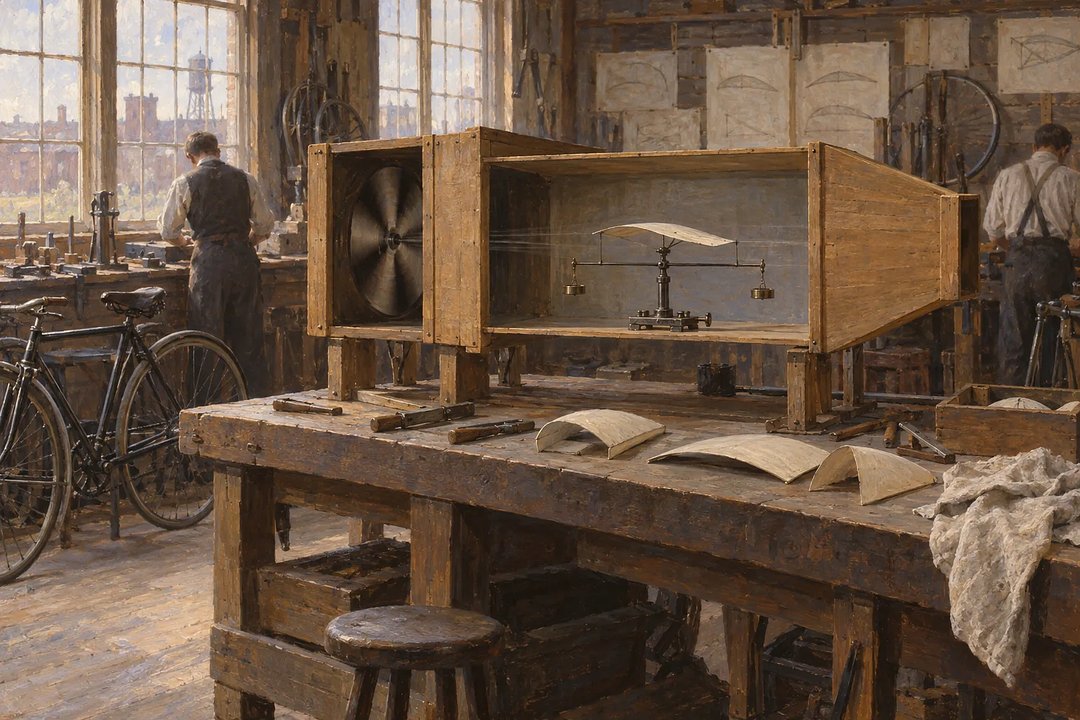
The engine alone does not explain the achievement. The 1901 glider produced about one-third of the lift their calculations predicted. Wind tunnel tests helped them measure how wing shape affected lift, the force supporting the aircraft, and revise their design.
In 1902, they linked wing warping, which changes lift between the wings, to a movable rudder. That connection reduced unwanted changes in direction when banking. Control developed before the engine was added, helping explain how powered flight became possible.
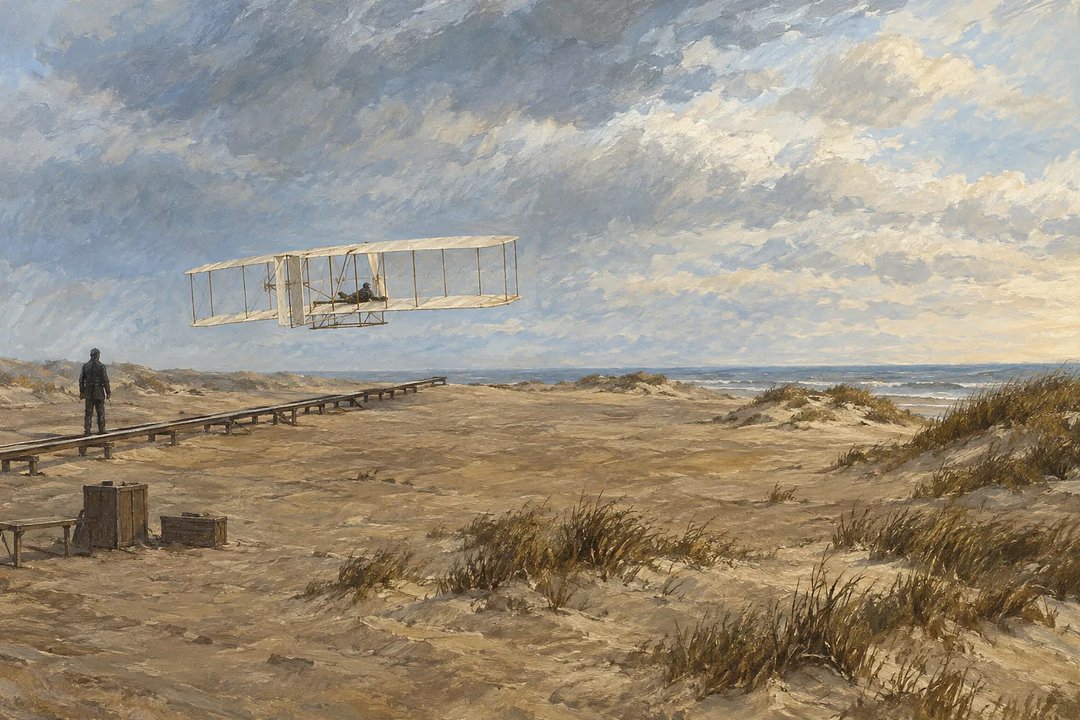 Biplane rising above a wooden launch rail on sandy dunes, with a prone pilot and a person standing nearby
Follow the Wright brothers' research sequence
In the original article on Injoys, you can follow a dated timeline and compare the four flights in a record table. Its distinction between measurements, design changes and documentary errors helps explain both the engineering and the conflicting flight times.
Read the full article on Injoys
A short check before citing a flight time
When preparing a caption or school note, you can use this check to keep separate events from becoming one statistic:
- First flight: Orville, 12 seconds, 120 feet over the ground.
- Fourth flight: Wilbur, 59 seconds, 852 feet over the ground.
- Telegram: 57 seconds was an error in transmitting the longest flight time.
Keep the location and date clear
If you are describing the December 17, 1903 flights, name Kill Devil Hills, North Carolina, in the United States. Kitty Hawk is the nearby town whose name is widely associated with the event. After the fourth flight, a gust overturned and damaged the aircraft; the 1903 Flyer never flew again.
Common questions
How did bicycle work support the experiments?
The bicycle business funded the research. Repair and manufacturing experience, tools and shop space also helped the brothers make airplane parts.
Did their research begin without outside help?
They drew on earlier research, including Lilienthal's work. Publications obtained from the Smithsonian and exchanges with engineer Octave Chanute also informed their investigations.
Was the 1903 Flyer a practical airplane?
It demonstrated controlled powered flight. Development toward a practical aircraft capable of sustained turns continued with the 1905 Flyer III.
Compare the historical records
For a closer check, compare the diary and telegram explanations in the original article on Injoys before using a flight time in a report.
Read the full article on Injoys
This post was written with assistance and published on a channel run by Injoys (injoys.com). The original article and its sources are at the link above.


Comments
Post a Comment